When the gears of the pocket watch bit for the first time, the world melted into a piece of coarse black and white in front of my eyes. One second, I was still standing on the rotten deck, and the next second, I was in an absolutely still moment — the sailor’s body was hanging in mid-air, with a frightened expression frozen on his face, and the waves behind him maintained the perfect arc before the break. I couldn’t call my name. I only knew that there was a “death watch” hanging on my chest that could see the moment of death, and the ghost ship named Obra Dinn in front of me was waiting for me to write the final footnote for the cause of death of its 60 crew members.
The investigation began with a corpse. I approached him, and the pocket watch pointed to the moment of death, and the world faded back to that moment. There was no dialogue, no guidance, only everything he had to observe by himself: the weapons in his hand, the blood stains under his feet, the opening and closing angle of a door in the distance, and even a frozen cry in the background. I need to remember every detail, because when time goes back, everything will return to silence. Only I can write down fragments such as “holding a knife, facing east, and ringing the bell three times” in my notebook. The game doesn’t provide a list. It trusts my eyes and memory.
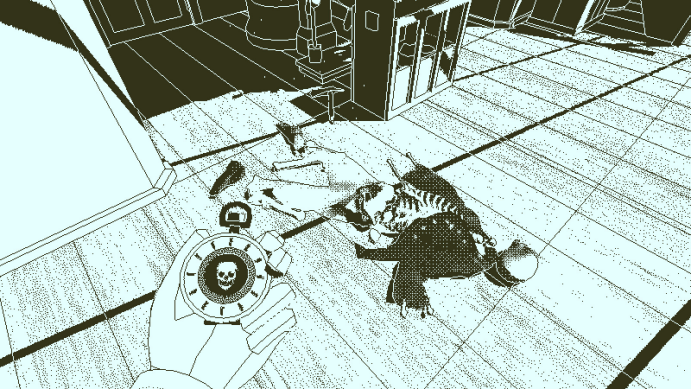
The most fascinating thing is those “connections”. When I confirm a person’s identity and cause of death, the pocket watch will guide me to another scene related to his death. Sometimes a few minutes ago, sometimes a few months ago, I was like a ghost jumping on the timeline, witnessing how a quarrel turned into revenge, and how a concealment caused a chain disaster. The perspective is always fixed. I can only stand in place and look around. This restriction makes the observation more focused — I have to identify faces from the reflection, guess the dialogue from the shape of the mouth, and infer the relationship from the placement of the items. The truth is not given, but “seen”.
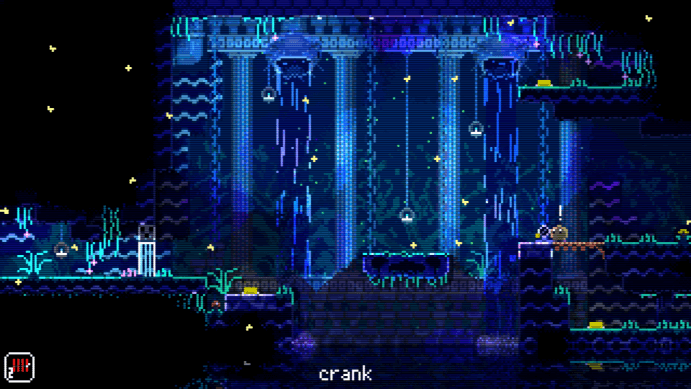
The black-and-white dot matrix picture felt simple at first, but later became the smartest design. After stripping the color, all the details are presented by light, shadow and shape, and the face of the character needs to be identified by the outline and characteristics. Clues are hidden in every corner of the ship — from the bottom cabin to the top of the mast. There is almost no music, only the sound of waves, the moaning of wood and the throbbing clicking sound when the pocket watch switches between time and space. This kind of minimalism makes the brain completely immersed in reasoning itself, and the world shrinks into a huge logical grid, and I am the only living point on it.
As the notebook was filled with pages, the story emerged by itself. It is not a linear narrative, but a collective tragedy through sixty moments of death. I found that every character has a name, past and motivation. They are not the background board, but the living people who weave this death web together. The most shocking moment is often not to reveal the murderer, but to understand why someone makes a choice — greed, fear, love, or desperate loyalty.
When the last person’s name and cause of death were confirmed, the pocket watch stopped turning. I closed my notebook and stood on the deck of returning to silence. There was no cheering, no ending animation, only the sea breeze blowing through the empty rope. But I suddenly felt a deep calm, as if I had just finished a long and quiet funeral for strangers.
After quitting the game, I looked at the flowing street outside the window and felt for the first time that everyone who passed by might be the protagonist of a complicated story. _Return of the Obra Dinn_ did not give me an exciting adventure, but gave me a pair of detective eyes and a heart of fear of the story. It makes me believe that the real puzzle is never “who did it”, but “why”. And every death, no matter how silent or chaotic, deserves to be seen seriously and completely — because in that quiet last moment, not only life, but also the whole and complex truth about human nature is frozen.