When Mr. Coo’s arm suddenly fell off and waved at him, my first reaction was not panic, but laughter. Then, his legs, ears and nose also defected one after another, jumping and disappearing into the crazy grass. Standing in place at this moment, only a stunned core of the torso is left. My name is Mr. Coo, a person who accidentally disintegrated in the surreal world, and my task is extremely absurd: to put myself back together. _The Many Pieces of Mr. Coo_ told me with a carnival of hand-drawn animation that broken is not the beginning of a tragedy, but an invitation to a grand treasure hunt.
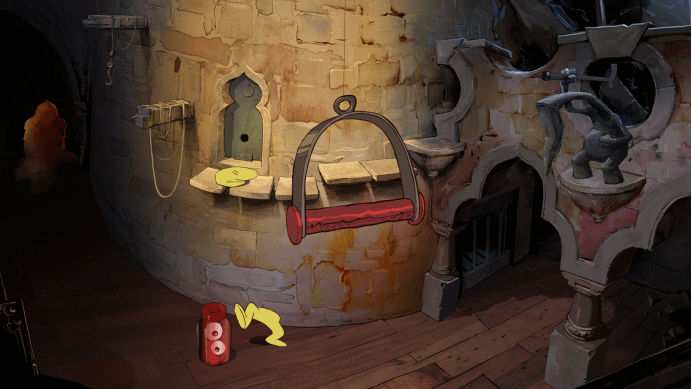
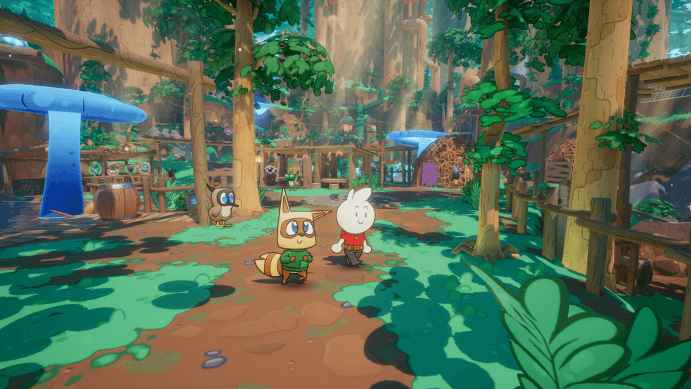
The world is a dream drawn frame by frame. Every blade of grass is trembling slightly, the clouds have the texture of crayons, and the lines of the mountains in the distance seem to be accidentally drawn crooked and too lazy to modify. The fragments of my body are hidden in this benevolent chaos: my left hand may play lonely notes on the piano keys, and my right eye may be stuck in the folds of a mushroom to observe the world. Looking for them does not rely on maps, but on intuition and reconciliation with absurd logic — for example, if you want to get the nose stuck on the top of the tree, you may need to coax a team of passing caterpillars to form a living ladder.
The core of solving the puzzle is to cooperate with those equally eccentric creatures. A mushroom with a horn mouth can help me “shout” the fragments of the high place; a piece of melancholy pink mucus is willing to be my temporary sole, as long as I listen to its story of falling in love. There is no menu for the interaction, only childish direct actions: shaking, dragging, clicking, or sometimes just waiting patiently — such as waiting for the snail walking behind my ear to finish its long circle. The return of each fragment is accompanied by a mini animation, as if the body is holding a private celebration for the return of each part of itself.
But looking for fragments is just an appearance. As the journey deepened, I found that each part of the body retained an independent “memory”. I remember someone’s hand in my right hand, and a forgotten lullaby is stored in my left ear, and the fragment of my heart, which always rolls away, seems to carry some heavy emotion that I dare not easily retrieve. The game becomes subtle here: I am not only reorganizing a body, but also sorting out a fragmented life. Those absurd encounters — such as arguing about philosophy with a talking teacup or helping a group of stars rearrange the constellations — have become metaphorical clues to my understanding of “who Mr. Coo is”.
The visual style itself is a narrative. The hand-painted lines are not perfect. There are often shaking brushstrokes and casual color overflows, which makes the whole world full of life. When my body is gradually complete, the saturation of the picture will also quietly increase, as if with the gathering of souls, the world becomes more and more real. The most shocking moment happened when all the fragments were almost back in place. The game would briefly cut into a smooth traditional animation, giving me a glimpse of the elegance and calmness that Mr. Coo might have when he was “complete” — that amazing glance gave weight to all the previous absurd pursuits.
Finally, when the last fragment (the always disobedient left toe) was persuaded to return to the team, Mr. Coo stood in front of the mirror. The image in the mirror is still funny, and there are obvious gaps in the stitching. But I controlled him to bow, and all the fragments responded synchronously. There is no golden transformation, only a deep and funny acceptance. It turned out that the completeness was not flawless, but all the parts finally agreed to play a role called “I”.
After exiting the game, I subconsciously touched my arms to make sure that they were still connected to my body. _The Many Pieces of Mr. Coo_ didn’t give me a serious answer about existentialism. It gave me a box of crayons that would run away and a permission to redraw myself. It quietly reminds us that each of us is composed of countless fragments — memories, traumas, dreams, absurd thoughts. The real completeness may not be to eliminate the cracks, but to learn to be like Mr. Coo, when the body (or mind) is scattered, he can embark on the absurd journey to find himself with curiosity and humor. After all, there are many crooked lines in the hand-drawn animation of life, and it is those crooked lines that make up the unique us.